
Improving data discovery for academic research: usage trends from Dewey’s MCP and AI-assisted search

Seven months after launching our MCP and AI Search, Dewey takes a look at how our researchers are using these tools to discover, evaluate, and explore data.
Whether you are a researcher trying to find the right dataset for your next project, or a librarian navigating a disparate and diverse landscape of data sources for researchers across departments, matching the right dataset to a research question is no simple task. With data sources expanding, and an increasing demand for alternative data, Dewey aims to build cohesion and simplicity in data access and evaluation. That is why we launched our MCP and AI Search in March of 2026, to meet researchers where they already work and improve the discoverability of data within our growing catalog.
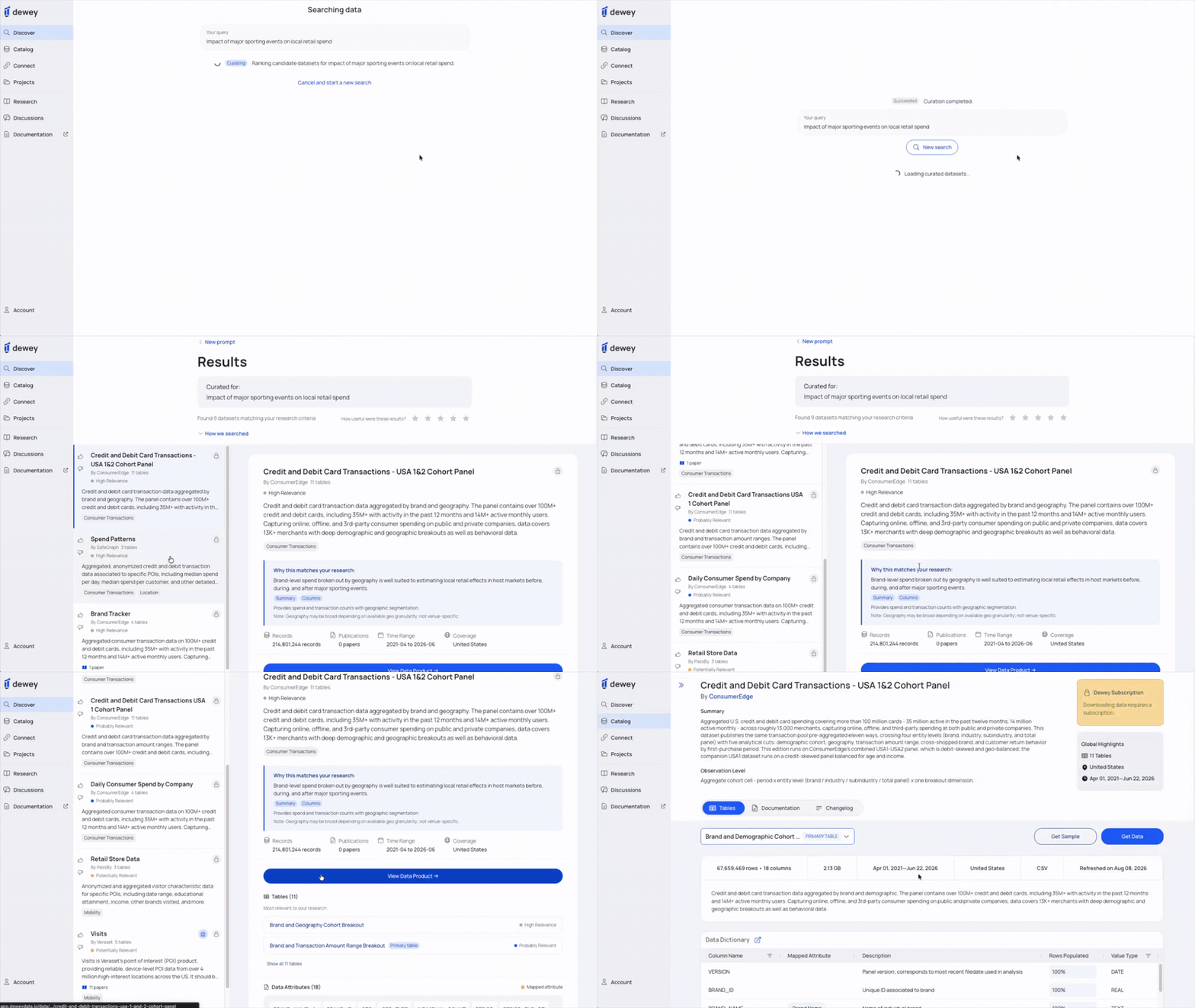
AI Search in the Dewey Platform
AI Search in the Dewey Platform not only allows you to ask questions in natural language, but it also provides rich context in response: ranked dataset suggestions with curated relevance reasoning, dataset coverage and table details, mapped attributes, and example publications utilizing the data.
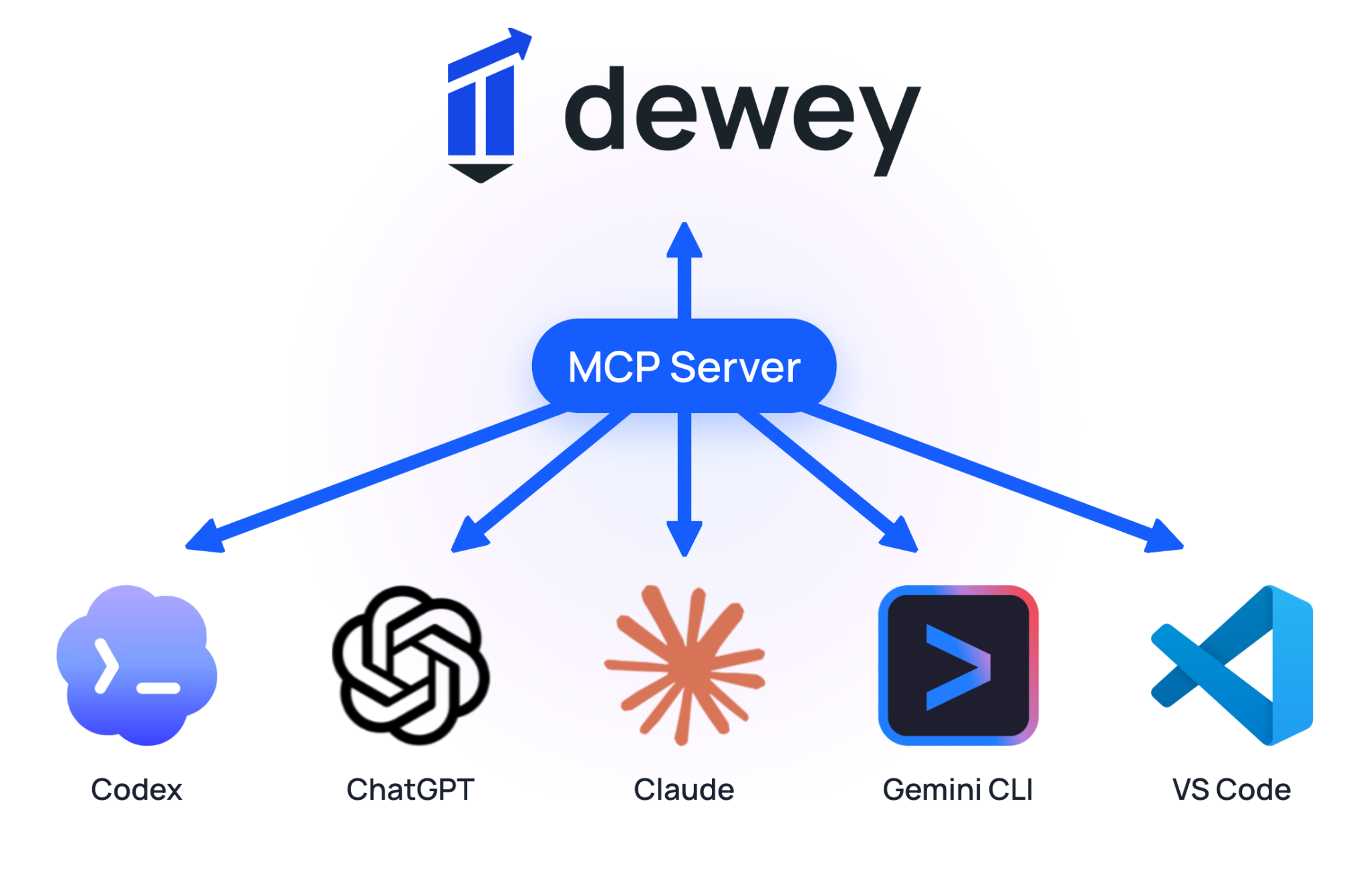
Dewey MCP (Model Context Protocol)
As recent research has shown, most researchers now use AI tools in their work, and the majority of them use general tools like ChatGPT rather than tools specialized for research or science (Wiley, 2025). However, these tools can only surface the information they are connected to. With the Dewey MCP (Model Context Protocol), we can provide a secure connection between the Dewey catalog and the environments researchers use every day, allowing subscribers to search datasets, evaluate schema and documentation, and explore data samples and access options.
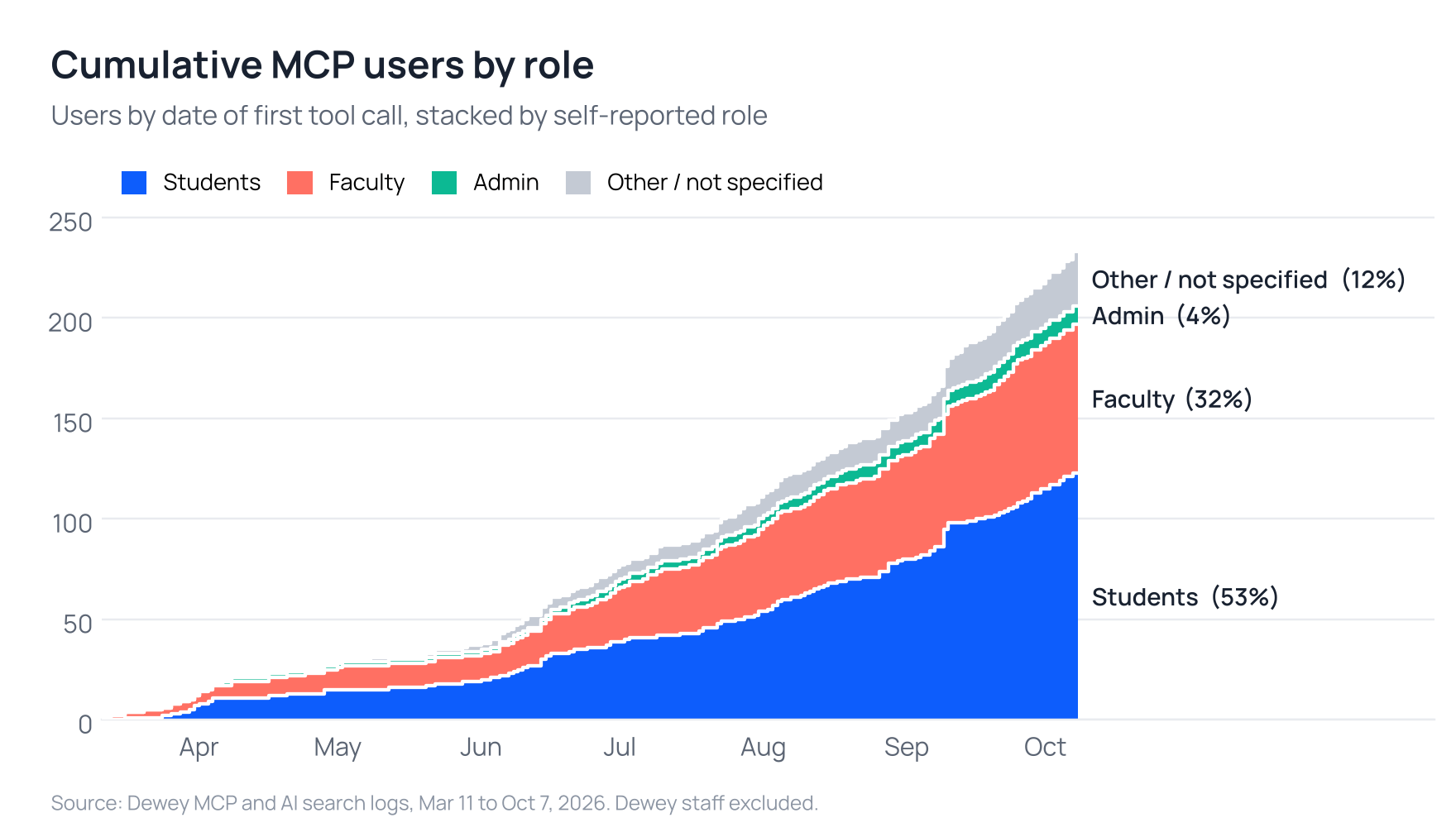
Looking at the usage trends for these integrations, we are seeing that researchers are not only using these AI tools to find data, but also to evaluate whether a dataset will work for their research question.
Who has been first to adopt AI tools for data discovery?
Just over a quarter of the researchers who logged into Dewey last month utilized the AI Search ability; and monthly MCP users grew nearly five-fold over the last 6 months. Students have been utilizing the MCP most, representing over half of MCP users. While this closely corresponds to Dewey’s user distribution (students being 49% of subscribers), it may also reflect how students are spending more time in data exploration, and leading the way in adapting to new tools and making the most of the technology available to them.
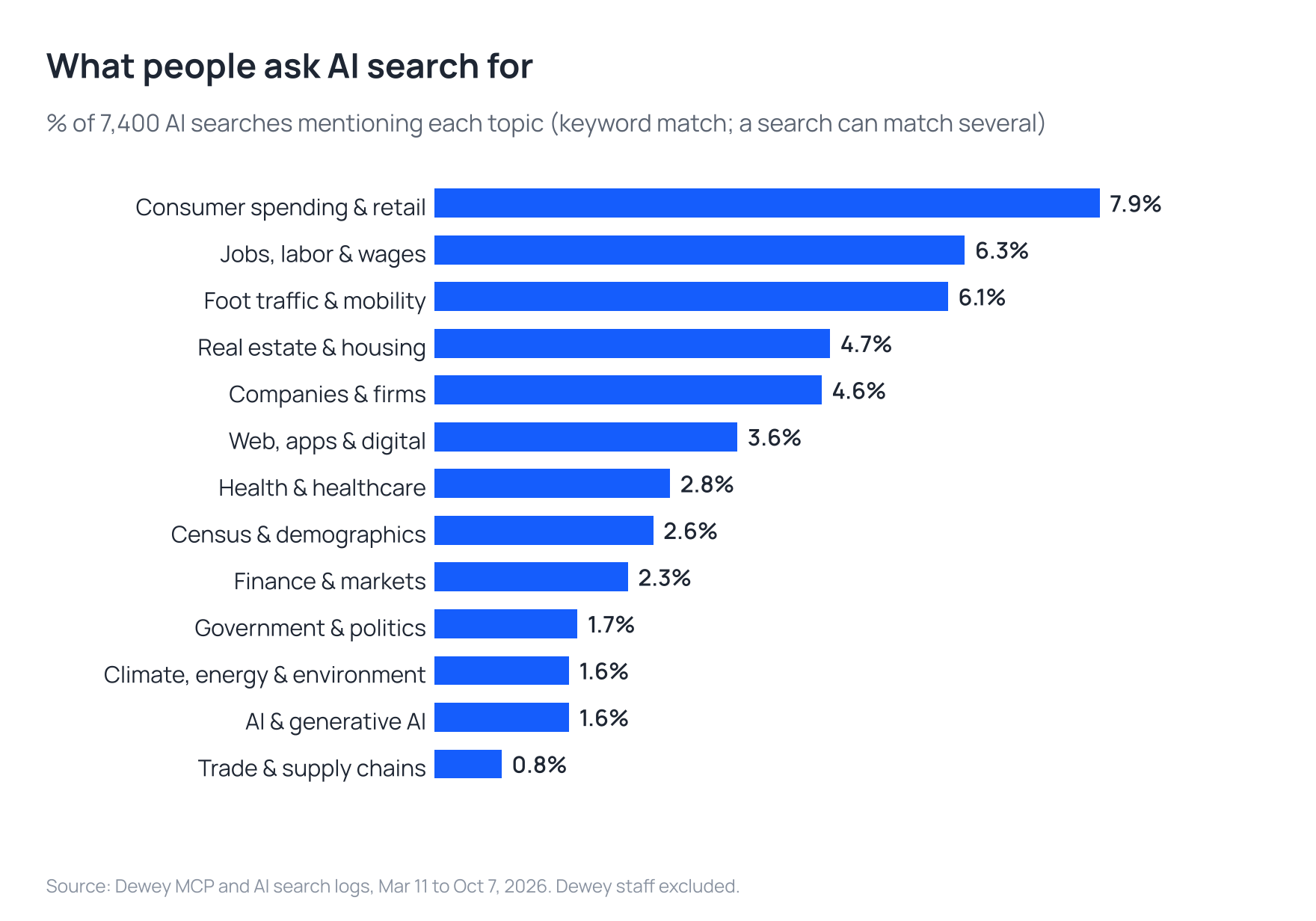
What are researchers asking AI tools?
Researchers across disciplines use the MCP and AI Search in a variety of ways to find, evaluate, and access data. Here are some examples that reflect common patterns in the questions researchers ask, paired with the datasets surfaced as a response:
- "How quickly are firms adding AI skills to their job requirements, and does their workforce change afterward?" (management, accounting)
LinkUp Job Records: full-text job descriptions and occupation codes measure AI skill demand by firm and month.
People Data Labs: company records add monthly headcount by role to test whether hiring follows.
- "Are households moving out of high-rent metros, and where do they go?" (demography, sociology)
Infutor: address histories with move dates trace origins and destinations.
Dwellsy: listing-level asking rents with unit details and listing dates compare housing costs at both ends of the move.
RentHub: rental listings can be used to study affordability differences across metros and potential destination markets households may favor after leaving expensive areas.
- “How does climate or nature affect health outcomes?” (climate, health)
ClimateCheck: Climate hazard and risk ratings for heat, precipitation, drought, flooding, and fire by ZIP code, useful for studying health impacts of climate stressors.
NatureQuant: Urban heat index scores can proxy heat exposure, and Nature Score represents urbanity to bio-diverse environment scales that may relate to physical or mental health.
- “Do companies that increase federal lobbying go on to win more government contracts?” (political science, accounting)
TenderAlpha: daily receivables and obligations panel follows ticker-mapped federal suppliers’ contract dollars over time.
LobbyingData: adds federal lobbying activity for the same firms. Note: panel covers publicly listed suppliers, so private contractors fall outside the sample.
BrightQuery: SBA loan-level records across PPP, 504 and 7(a) are paired with borrower records that include founding date, location and ownership classifications, plus employment and payroll.
- "How does social media influence purchasing behavior?" (consumer behavior, media)
Context Analytics: Direct, daily social-media sentiment and volume metrics dataset from Twitter, useful for studying whether online buzz is associated with brand-specific consumer behavior.
Consumer Edge: Brand-level, daily spend broken out by demographic groups and online/offline channel splits provide strong outcome measures for mapping purchasing behavior to social media activity over time.
Veraset: POI visit data can be used to test whether social-media-driven interest corresponds with changes in store visitation, a proxy for purchasing behavior.
Are these AI tools effective in matching researchers with the right dataset?
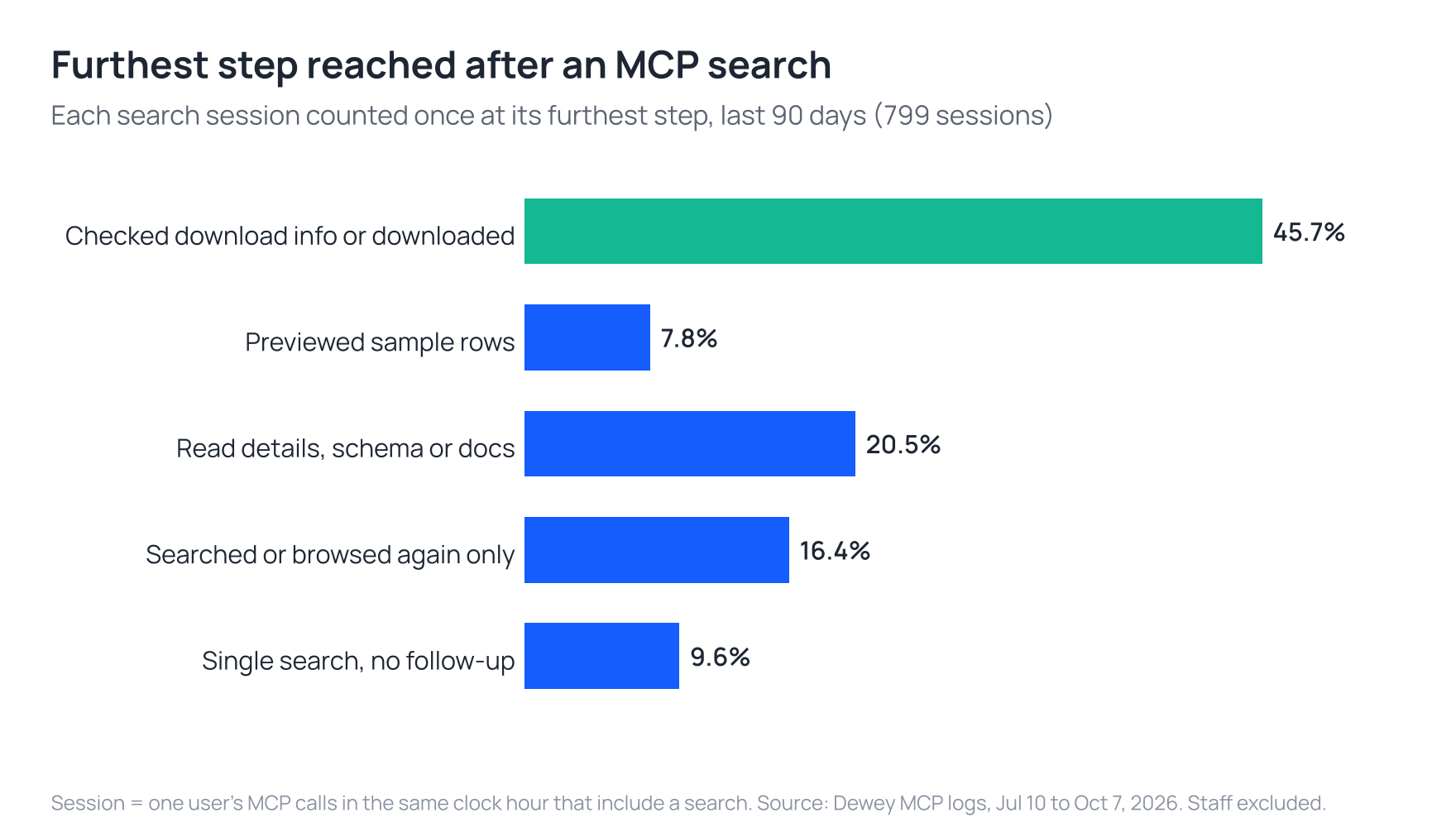
Looking at the outcome trends across users, we see how these tools are effectively connecting researchers with data, moving beyond search to evaluation and downloading. In MCP search sessions over the last 90 days, 46% reached download information (how to get the files) or downloaded directly. Another 28% went on to read documentation or preview samples, and only 10% ended after a single search.
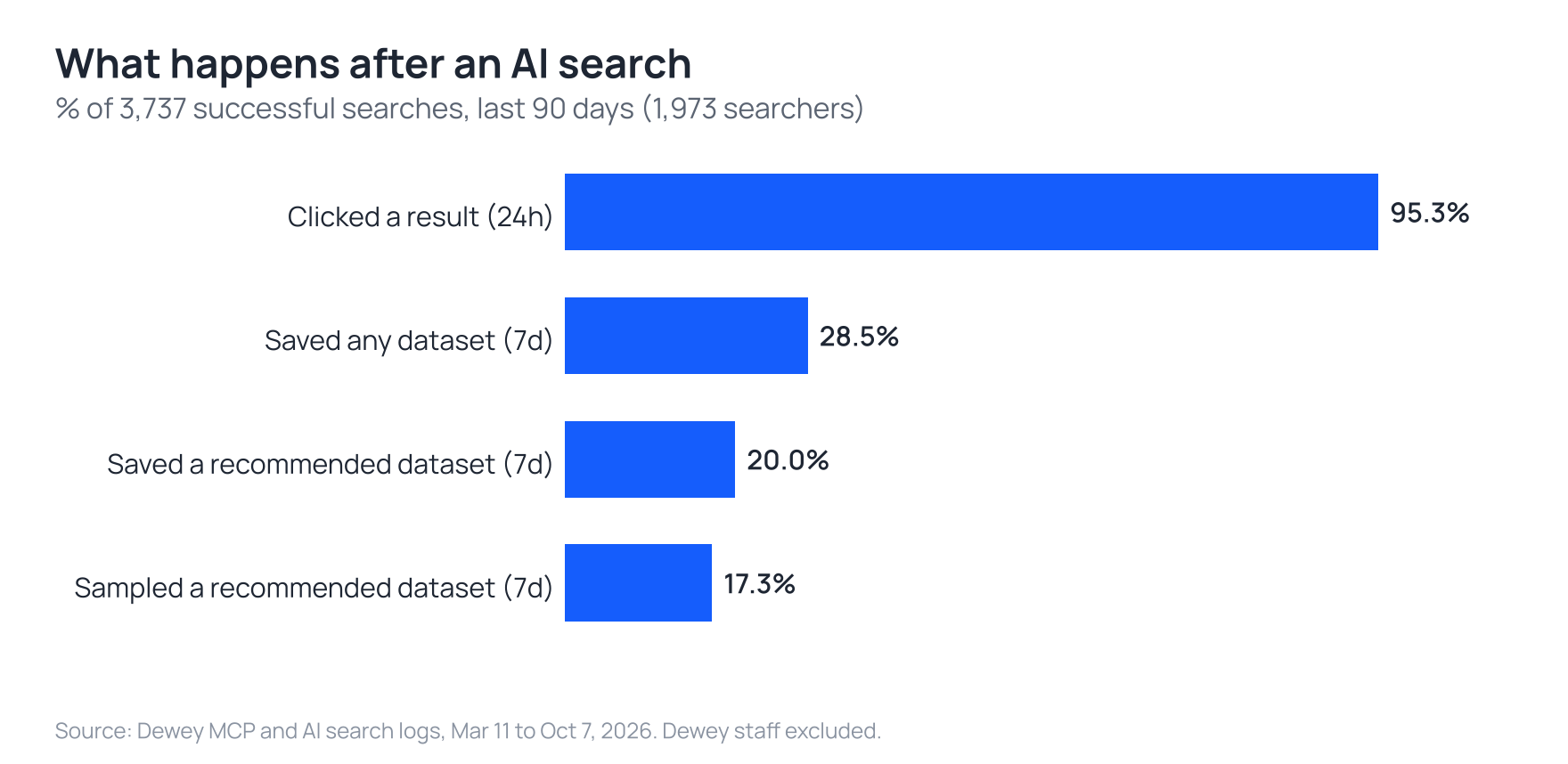
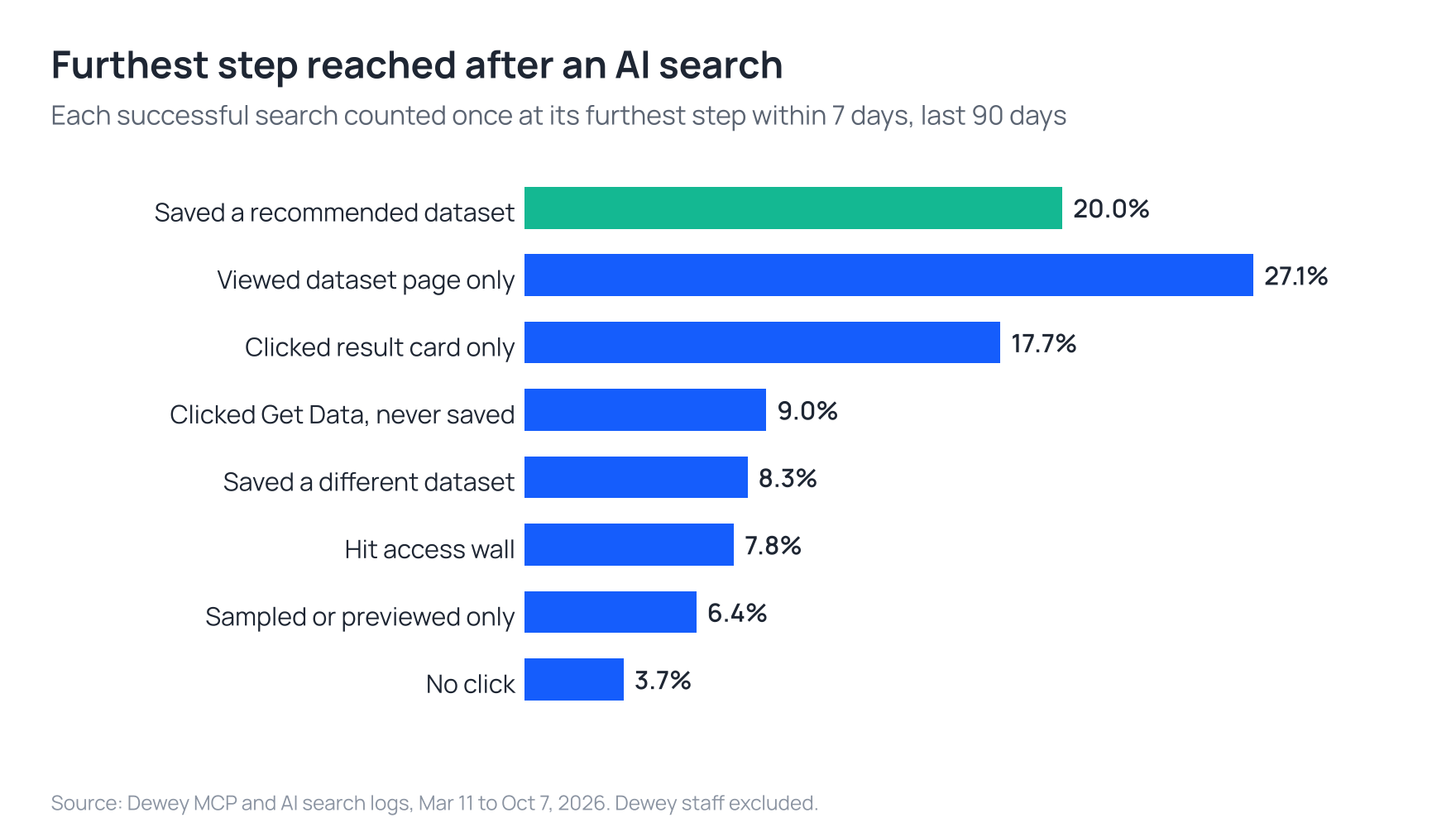
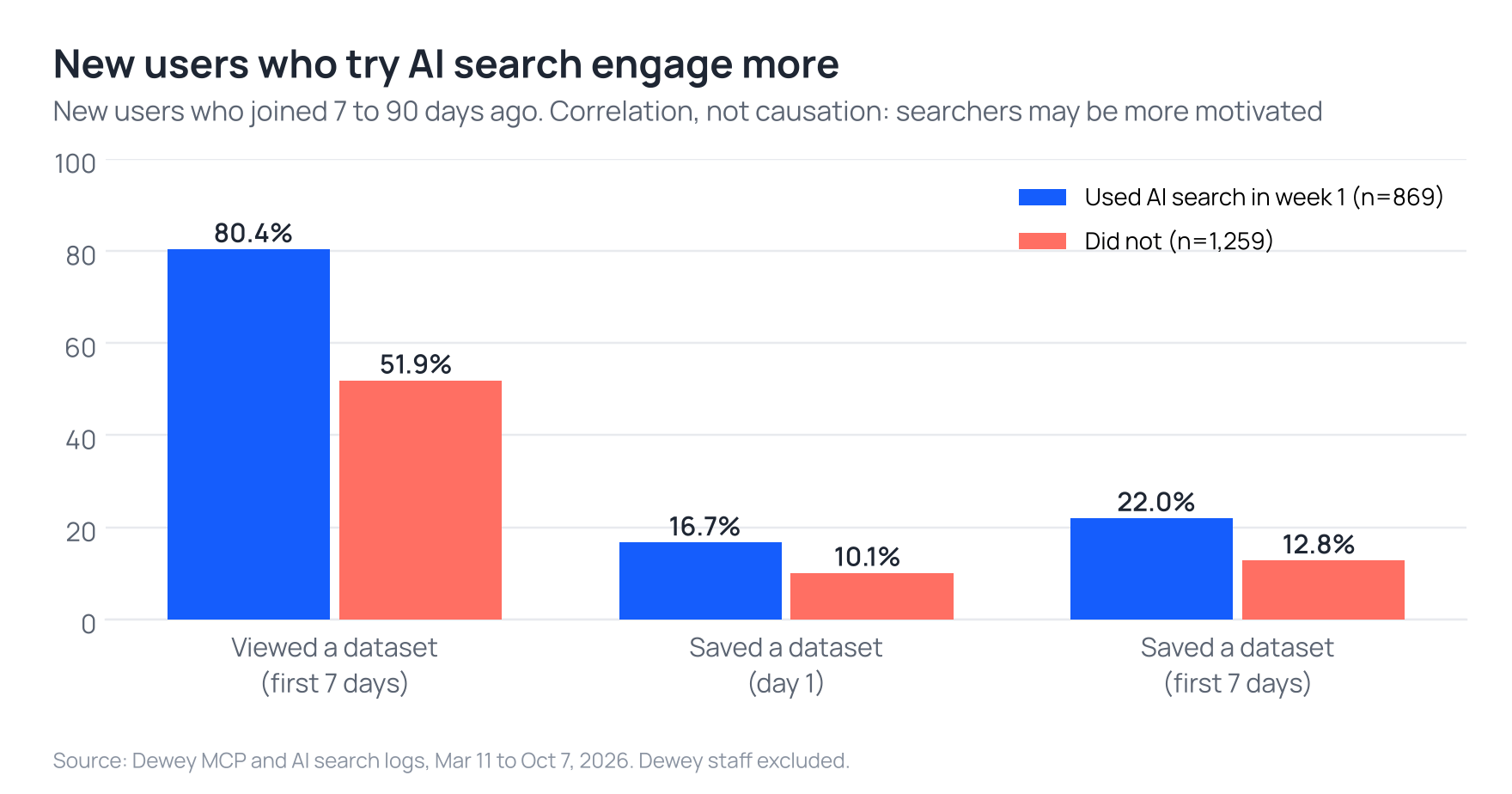
On the platform, 95% of successful AI searches led to exploring a dataset page, and 20% led to saving a recommended dataset within a week.
From discovery to evaluation: what are the top functions researchers call for through Dewey’s MCP?
Nearly every MCP user searches the catalog (91%), about 70% check download information or view a schema, and more than half preview sample rows.
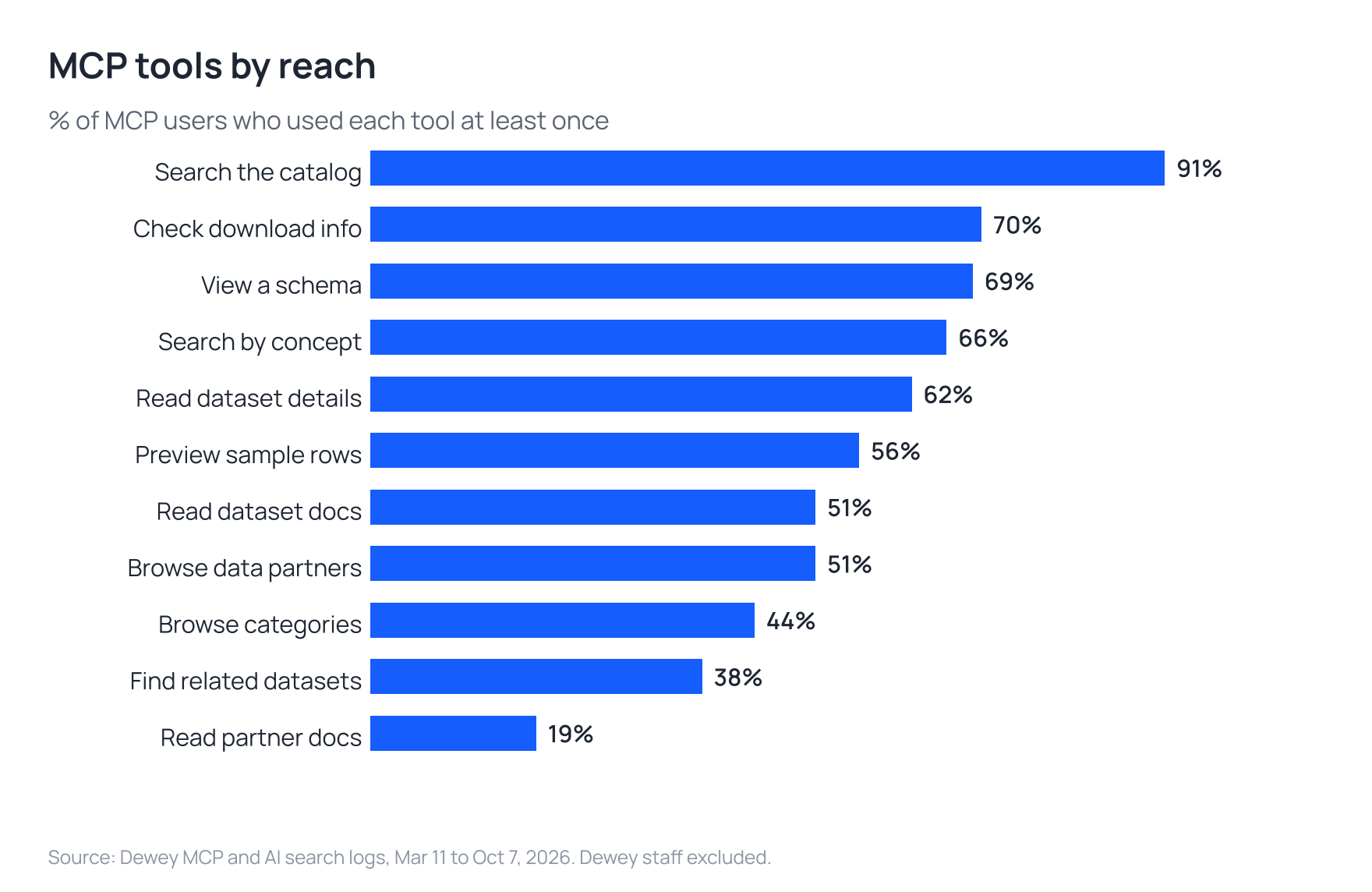
Finding a dataset is only the first step. Nearly half of all MCP activity (45%) is evaluation: pulling dataset details, schemas and documentation.
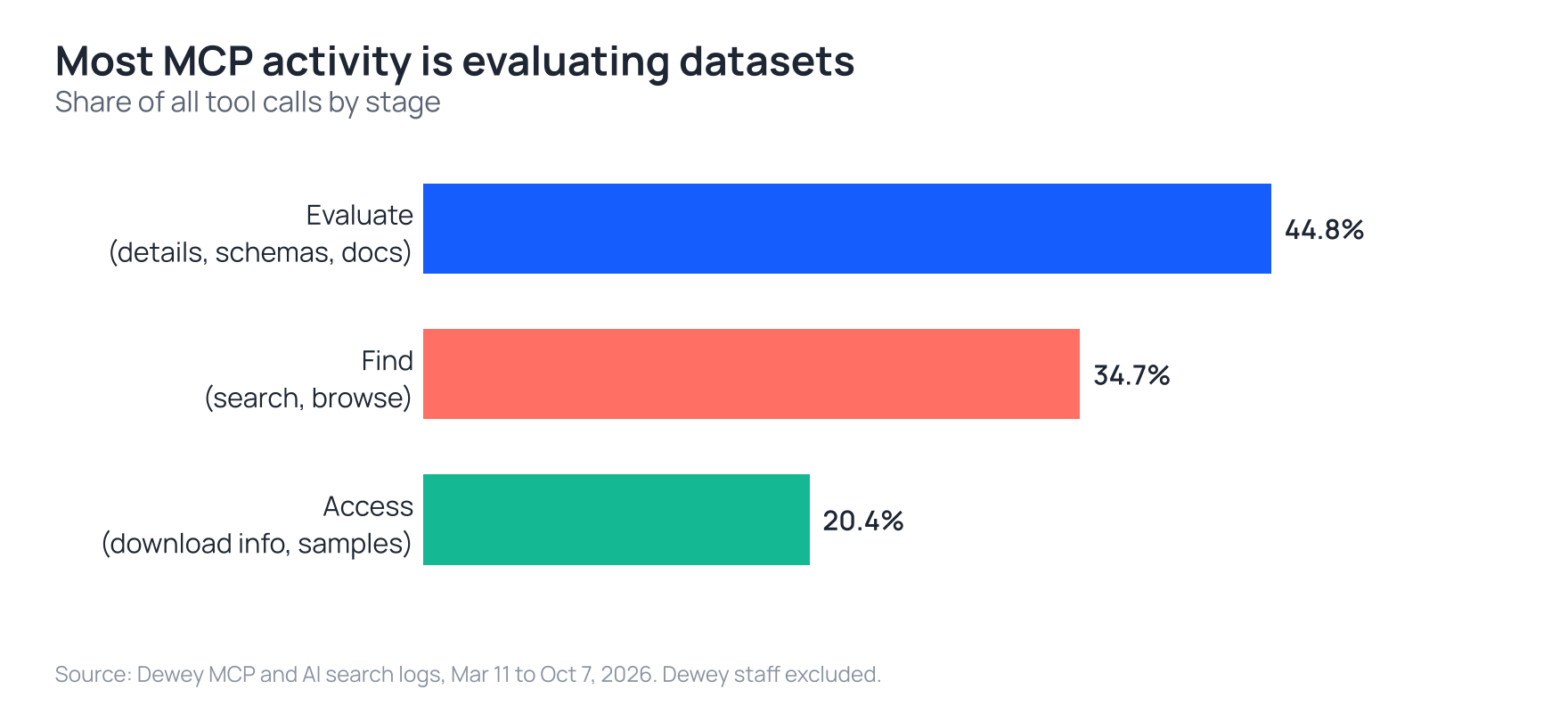
Researchers are checking coverage, scope, and granularity to assess whether a dataset will suitably answer their research question. Being able to evaluate these details before going through the download process saves valuable time and effort, while also expanding what can be accomplished during a data evaluation session. Alternative data sources can offer unique perspectives or novel insights, with improved recency and time granularity, real-life behavioral tracking, or expanded coverage compared to traditional data source. However, implementing these datasets in nascent research designs and innovative computational approaches takes a lot more effort upfront to determine if a dataset fits the research question. With these integrations, we hope to support this expansion in research through improved data access, which all starts with discovery and efficient evaluation.
What does this mean for libraries looking to improve research data discovery & evaluation?
- Discovery follows researchers into their AI tools. When a licensed resource is connected, it can appear in their answers; when it is not, the AI cannot recommend it. The MCP allows secure connections to bridge the gap between where researchers work and the information they are seeking.
- Metadata now has a second reader. AI tools read descriptions, schemas and documentation on a researcher's behalf, so thorough metadata makes it more likely that a dataset gets recommended.
- Information literacy still applies. The questions AI tools ask for researchers, about coverage, granularity and what a sample looks like, are the same ones librarians teach. Students still need to learn the right question to ask, and recognize what a source leaves out.
- Setup is light. Institutional subscribers have nothing to configure. Researchers connect with their own API key, and existing licensing and access rules apply. Libraries that already keep a Dewey research guide, such as those at the University of Washington and the University of Chicago, can add the MCP setup guide alongside it.
Closing the data discovery gap together
As Dewey’s catalog continues to grow, we’ve heard from our researchers that it can be overwhelming to navigate datasets and find what is most useful for their work. Dewey is dedicated to not only improving this data discovery and evaluation process, but also expanding access to alternative datasets for researchers across disciplines. By embracing a tech-forward approach, we are laying the foundation of support for the expansion of alternative data in academic research.
If your library is thinking about how to bring specialized data into the tools your students and researchers already use, we would like to talk.
Happy researching!
Resources
- Dewey MCP setup and usage guide
- Browse the Dewey Catalog
- The power of alternative data for academic research
About the data
Figures cover March 11 to October 7, 2026, and exclude Dewey staff accounts. MCP users are accounts with at least one tool call; a session is one user's MCP calls within the same clock hour. MCP search outcomes count each search session in the last 90 days once, at its furthest step. AI search outcomes count each successful search in the last 90 days once, at its furthest step within seven days, so the two outcome charts are not directly comparable. Example questions are representative composites, not actual requests.


