.svg)
Explore Dewey Data from your AI tools: Introducing our new MCP

If you don't know what a MCP is, this post probably isn’t exciting, and that's okay. Continue using the platform as you have been, the MCP will be here for you when you're ready.
If you're an academic researcher who's already familiar with MCPs, we built this for you!
Dewey now has a Model Context Protocol (MCP) server
A MCP (Model Context Protocol) is an open standard that lets AI tools like Claude or ChatGPT connect directly to external data sources and services. Think of it as a universal plug that lets your AI assistant reach outside itself and actually do things on your behalf.
That means our Dewey subscribers can connect directly to Dewey's full dataset catalog from inside their preferred AI tools (Claude, ChatGPT, Gemini) to find and qualify the data they need, fast. Once configured, your AI assistant can search datasets, explore schemas, preview sample data, and retrieve download details, all without leaving your development environment.
This is not a replacement for the Dewey platform. It's an extension of it, built for the researchers whose work already lives inside AI-native workflows.
Putting the Dewey Data MCP to work
Once connected, you can interact with Dewey's data universe without ever leaving your AI environment.
- Search datasets by prompt. Describe your research question in natural language and surface relevant datasets from Dewey's catalog: foot traffic, consumer spending, labor market data, real estate, firmographics, web traffic, and more.
- Peruse and evaluate datasets. Browse dataset documentation, coverage details, and attributes directly in your AI tool, no tab-switching required.
- Download data. Initiate downloads from within your workflow, so your data pipeline stays in one place.
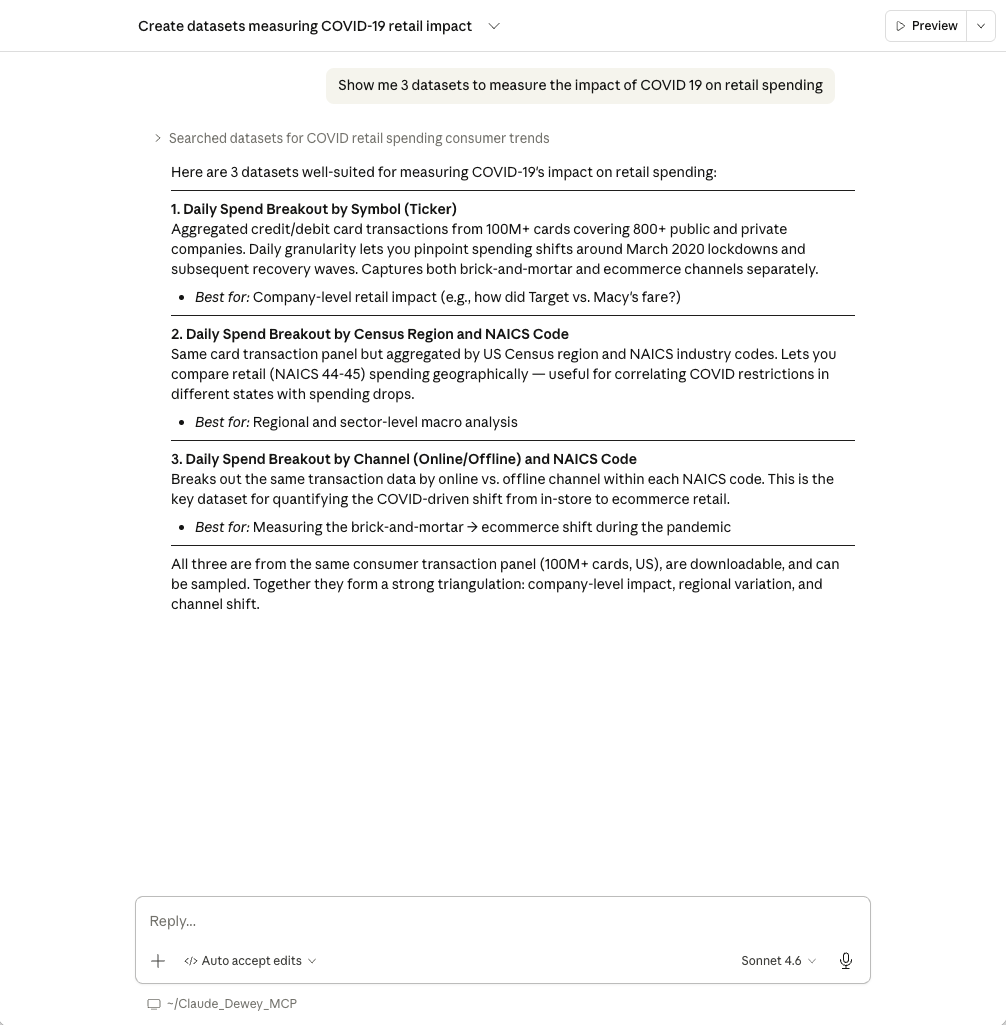
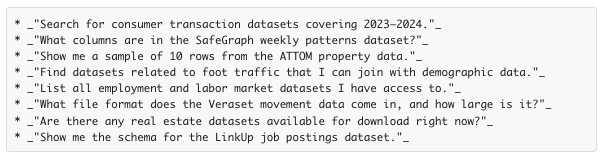
Sample prompts:
How to set up Dewey’s MCP
Before getting started, note a few important prerequisites. You must have an active Dewey subscription to log in and authenticate. Users will also need their Dewey API key handy. Check out Dewey’s documentation for instructions on how to generate one.
Installation guides for Claude Code, OpenAI Codex, and Gemini CLI can also be found at docs.deweydata.io.
If you run into issues or have feedback, we'd love to hear it. The MCP is new, you're exactly the right people to stress-test it, and we'll iterate fast.
A note for librarians
If you manage a Dewey institutional subscription, here's what this means for your researchers: the MCP gives technically-inclined faculty and graduate students a new way to access and discover Dewey data directly within AI tools they're already using. It doesn't change licensing terms, usage policies, or anything about how your institution's subscription works, it's simply another access point for subscribed users.
You don't need to configure anything on your end. But if researchers come to you asking about connecting Dewey to Claude or ChatGPT, point them to Dewey’s documentation and confirm they're covered under your institution's active subscription.
As always, standard Dewey usage terms apply, including restrictions on sharing raw data outside authorized research teams.
For our data providers
Your data is protected. Nothing about the MCP changes licensing, access controls, or how your datasets are distributed. Again, access is only for subscribed researchers, exactly as before.
What does change: discoverability. When a researcher describes their project to an AI tool and Dewey's MCP is in the loop, your datasets now have the opportunity to surface at the exact moment someone is looking for what you offer. That's a meaningful shift in how researchers find and choose data.
Now is a great time to make sure your dataset descriptions and documentation are thorough, including coverage details. If your metadata isn't strong, your data may get passed over.
We're thrilled to see academic researchers unlock the power of Dewey directly in their AI tools. Keep us in the loop with your feedback and any future requests! [email protected]




.svg)